Every fleet leader lands in the same uncomfortable spot. You need visibility into what happens on the road, because you are accountable for crashes, claims, and the safety of your people. Your drivers see a camera pointed at their face and a score attached to their name, and they start wondering whether the company trusts them.
The hardware does not decide how that lands. Two fleets can install identical AI dash cams and end up somewhere completely different. One builds a program drivers defend to their friends. The other gives good drivers a reason to update their resumes.
The short version: surveillance collects evidence about drivers, and coaching uses information with them. Surveillance asks who messed up. Coaching asks what happened and what would help next time. Both run on the same data. Only one lasts. Which raises the question underneath all of this. What is defensive driving, really, and can technology produce it? Technology helps. It cannot do the job alone.
What is defensive driving?
Defensive driving is operating a vehicle to prevent crashes, injuries, and losses regardless of road conditions or what other drivers do. The National Safety Council defensive driving program, which grew out of the first such course in 1964, builds its training around behavior, judgment, decision making, and consequences.
For commercial drivers, that definition becomes a specific, repeatable set of habits:
Scanning far enough ahead to see hazards develop instead of reacting to them
Holding a safe following distance sized to the vehicle, its load, and its real stopping distance
Adjusting speed for traffic, weather, visibility, and road surface
Keeping distractions out of the cab
Managing speed on curves, grades, ramps, and job site approaches
Watching what other road users are about to do, not only what they are doing now
Choosing the option that reduces preventable risk, even when it costs a few minutes
Here is what matters most for fleet leaders: Defensive driving is a set of behaviors that decays without reinforcement, which is why the answer to what defensive driving is always comes back to training, feedback, and practice.
A camera can tell you a driver followed too closely on Tuesday. Only coaching turns that into a proper cushion on Wednesday.
Driver coaching and driver surveillance are not the same thing
Both use the same raw material. They differ in purpose, and drivers pick up on that difference fast.
Surveillance feels like this from the driver seat: someone is always watching, mistakes get collected, discipline arrives without explanation, and the rules shift depending on who reviews the clip. Almost nobody sets out to build that. It happens when technology gets deployed faster than the process around it.
Coaching works on patterns rather than isolated incidents, supplies context before conclusions, delivers feedback while it still means something, credits safe behavior as reliably as it flags risk, and treats improvement as shared work.
There is real evidence for which approach moves the needle. An FMCSA-funded evaluation of onboard safety monitoring at two carriers ran a four-week baseline in which cameras recorded events, but the in-cab feedback light was switched off, and managers could not see the footage. In the 13 weeks that followed, managers got access and worked through a coaching protocol with drivers. Recorded safety events per 10,000 miles fell 38.1 percent at one carrier and 52.2 percent at the other, and the researchers attributed the drop to monitoring combined with coaching rather than the monitoring alone.
That study dates to 2010 and the technology has moved on, but the finding has not. Recording behavior changes little by itself. Talking with drivers about it changes a lot.
| Surveillance-first | Coaching-first | |
|---|---|---|
| Purpose | Document mistakes and assign blame | Reduce future risk and build skill |
| Communication | Announced late, explained thinly | Explained before rollout, written into policy |
| Use of data | Evidence for discipline | Input for conversation and training |
| Driver experience | Watched, judged, left guessing | Informed, supported, able to respond |
| Cultural impact | Grudging compliance and workarounds | Ownership, trust, and lasting change |
What a coaching program costs you in time
The fair objection to all of this is time. Your supervisors already cover dispatch, job sites, and their own paperwork. A coaching program sounds like another job stacked on top.
In practice, a working rhythm is smaller than people expect:
A weekly look at your highest and lowest performers instead of every driver every week
A short conversation with the drivers whose trends actually moved, not a sit-down for every flagged event
Geofences and filters that strip out the events your routes make unavoidable, so nobody spends their week dismissing noise
One monthly review of the fleet-wide trend to check whether the coaching is working
Geiger Ready-Mix runs that rhythm across 130 trucks, with plant managers doing the coaching rather than a dedicated safety department.
And the time cost you are already paying is the bigger one. A single crash investigation, insurance claim, or driver replacement eats more hours than a full quarter of weekly reviews.
Why the difference matters for driver retention
Replacing drivers is slow and expensive. The Bureau of Labor Statistics projects roughly 237,600 openings per year for heavy and tractor-trailer truck drivers through 2034, and most come from replacing people who leave rather than from growth. Fleets compete for the same experienced people, and a driver with a clean record has options.
Cameras do not cause turnover, and no credible research says they do. What the research actually points to is narrower and more useful: the purpose behind the monitoring is what tracks with harm. One note before the numbers. This work covers monitored workers across industries rather than drivers specifically, so read it as a signal about how monitoring lands, not as a study of fleets.
A 2024 national survey of 1,273 U.S. workers found that monitoring used to protect health and safety or help people improve showed no relationship to negative wellbeing outcomes. Monitoring understood as a tool for discipline or for discouraging workers from raising problems tracked strongly with them.
The gap between those two groups is wide. Among workers who strongly agreed their employer used monitoring to discourage speaking up, 67 percent said they had to work faster than was safe or healthy, against 14 percent of those who strongly disagreed.
That survey also found transportation among the most heavily monitored sectors in the country, so fleet drivers are not guessing about whether this applies to them. Notably, only 42 percent of monitored workers believed the technology was there to protect their health and safety. That gap between what safety technology is for and what workers think it is for is the gap fleet leaders can actually close.
Related work from the American Psychological Association found workers who knew they were monitored were likelier to rate their mental health poor or fair than workers who were not, 32 percent against 24 percent.
Translate that to a truck cab. Drivers accept safety technology when they can answer a short list of questions. Why is this being installed? What is collected, and what is not? Who sees it? How long is it kept? How is my score calculated? What triggers a conversation versus discipline? How does this protect me if someone claims I caused a crash? What do I do if an event gets flagged wrong?
Fleets that answer those up front get cooperation. Fleets that leave them open get rumors, and rumors are always worse than the policy you would have written.
Template for your fleet
What to tell drivers before install day
Starting [date], we are installing AI Dash Cams in every truck. Here is why, and here is exactly how it works.
The reason is simple. When something happens on the road, we want the facts. Right now we do not have them, and most of the time the facts are on your side.
The camera records when a specific event triggers it. There is no live feed, and nobody sits at a desk watching you drive.
Footage goes to [names or roles], and only to them. It is kept for [number] days unless it is tied to a claim.
Your score is built from [list the behaviors]. It moves on trends, not on one bad Tuesday, and safe driving raises it as reliably as risky driving lowers it.
A flagged event starts a conversation, not discipline. If the flag is wrong, or the route made it unavoidable, tell us. We will pull the video and fix it.
Six months from now we want [specific outcome]. We will show you the numbers either way, good or bad.
OSHA makes a related point in its recommended practices for safety and health programs. When management and workers collaborate to find and fix hazards before someone gets hurt, that collaboration builds trust and improves communication. OSHA also notes that injuries damage morale, productivity, turnover, and reputation. Safety and retention run on the same fuel.
How AI dash cams can support drivers instead of policing them
Not every dash cam does the same job. A basic recorder captures video for review after things go wrong. The AI dash cam capabilities in the IntelliShift platform are built for something else: catching risk while the driver can still act on it, and giving managers enough context to coach fairly. Specifically:
The AI Dash Cams in the IntelliShift platform recognize more than 40 driving behaviors and draws on more than 20 billion miles of real-world driving data, which helps separate a genuine safety event from a harmless movement.
Processing happens on the device through edge computing, which makes real-time in-cab audio coaching possible. The driver hears a prompt in the moment instead of a conversation three weeks later.
Video pairs with telematics signals like speed, location, and harsh braking, so a flagged event arrives with the surrounding facts instead of as a clip with no story.
The AI reviews 100 percent of drive time rather than waiting for someone to pull footage, so safe driving becomes part of the record, not just the exceptions. Driver Stars recognize individual moments of good judgment, including hard braking that avoided a collision.
When a driver gets blamed for something they did not do, video plus telematics often settles it quickly.
Geiger Ready-Mix shows the shift in practice. On its old human-review system, coaching happened only when a clip got flagged, so drivers got dinged for events and got no credit for the thousands of things they did right. After moving to IntelliShift AI dash cams, the 130-truck fleet holds a fleet-wide GreenZone® score above 900 and 97 percent stoplight compliance, and runs a weekly coaching rhythm reviewing the highest and lowest performers with plant managers. The safety leader converts justified hard-braking events into Driver Stars and builds his own geofences to filter out events the fleet cannot avoid.
None of this removes the manager from the loop. AI dash cams surface risk and supply context. Human judgment still decides what an event means.
How to use a driver scorecard without damaging trust
A driver scorecard turns scattered events into a comparable measure of how someone drives. GreenZone® driver scoring in the IntelliShift platform combines camera-detected behaviors with telematics signals into a single score per driver, then groups drivers for fair comparison and targeted coaching. IntelliShift reports that higher GreenZone® scores correlate with fewer accidents.
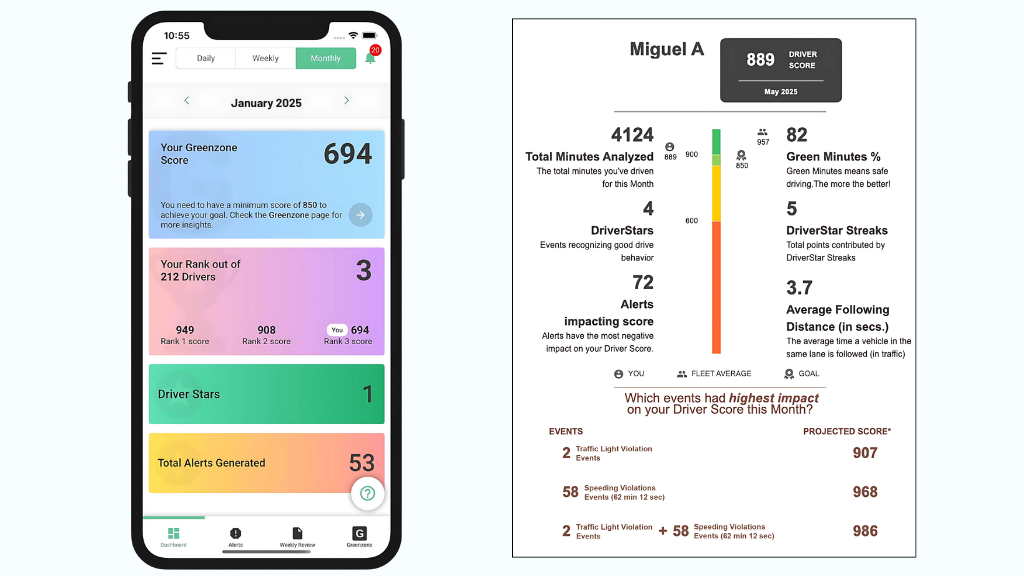
Scorecards go wrong in predictable ways. Drivers do not know how the score is built. Events get counted without context. Rankings get posted to embarrass people. There is no way to challenge a bad flag. Managers mention the score only when it drops. Two supervisors apply it two different ways.
Used well, the scorecard becomes the least emotional part of a coaching conversation:
Publish the criteria and the weighting, and explain both in plain language
Coach to trends across weeks rather than to one bad Tuesday
Check the video and the operational context before drawing a conclusion
Let a person, not a number, make the final call
Name strong performance out loud, and often
Set improvement targets a driver can actually hit
Give drivers a real channel to add context, and filter out events the route makes unavoidable
Apply the same standard to everyone, every time
Point the score at coaching and fleet safety training first, and at discipline only when coaching has not worked
How to build a coaching-first fleet safety program
OSHA’s recommended practices rest on seven core elements, including management leadership, worker participation, training, and program evaluation. Applied to fleet safety technology:
Explain the purpose before the install date, not after.
Put it in writing: what cameras capture, how footage is used, who has access, how long data is kept, and how scores work.
Tell drivers plainly what is monitored and what is not.
Train managers to coach. A coaching program run by untrained managers becomes a discipline program.
Review context before assigning blame.
Aim fleet safety training at the behaviors your data shows you actually struggle with.
Recognize safe habits as consistently as you flag risky ones.
Build a real path for drivers to raise concerns or dispute an event.
Measure improvement over time, and share the trend with the people producing it.
Review the program on a schedule, with driver feedback as a real input rather than a formality.
Fleet safety training works best when it is ongoing, specific, and tied to what your cameras and telematics actually show. An annual compliance session checks a box. A ten-minute conversation about following distance the week after three following distance events checks reality.
Coaching does not mean avoiding accountability
A coaching-first culture is not a soft culture. Some behaviors need a consequence, and pretending otherwise disrespects the drivers doing the job right. Fleet leaders still need to set clear expectations, document repeated risk, address serious violations, apply policy consistently, protect the public, and escalate when coaching has not produced change.
What escalation looks like in practice is a ladder everyone can see in advance:
1An in-cab prompt in the moment. No manager involved, no record beyond the event itself.
2A short conversation once a trend appears, focused on the behavior and the fix.
3Targeted training aimed at the specific behavior the data keeps showing.
4A documented conversation with a clear improvement target and a date.
5Formal progressive discipline under your existing policy.
Serious violations skip the ladder, and every driver should know which ones before they happen. Surprise is what turns accountability into surveillance.
The difference is not whether accountability exists. It is whether accountability is fair, transparent, evidence-based, and aimed at reducing future risk rather than building a file. Drivers can tell which one they work under.
Questions to ask before introducing safety technology
Work through these before the purchase order, not after the first complaint:
What problem are we actually trying to solve, and how will this protect our drivers?
Which behaviors will we measure, and why those?
How is the driver score calculated, and can we explain it in one minute?
Who reviews alerts and footage?
How will we train managers to coach rather than scold?
How can a driver add context or dispute an event?
Will safe driving get recognized as consistently as risky driving gets flagged?
What does success look like six months in, and how will driver feedback change the program?
Frequently Asked Questions
What is defensive driving?
Defensive driving means operating a vehicle to prevent crashes and injuries regardless of road conditions or what other drivers do. For commercial fleets that covers hazard scanning, safe following distance, speed management, adjusting for weather, and keeping distractions out of the cab. It is a set of habits reinforced through training and feedback, not a one-time course.
What is the difference between driver coaching and driver surveillance?
Surveillance collects evidence of mistakes and hands down consequences. Coaching uses the same data to identify patterns, provide context, reinforce safe behavior, and help drivers improve. The technology can be identical. The purpose, communication, and follow-through are what differ.
How can AI dash cams protect drivers?
They flag risk in the moment so a driver can correct before an incident, attach video and telematics context so reviews are fairer, and provide evidence when a driver gets blamed for something they did not do.
What should be included in a fleet safety program?
At minimum: a written policy, clear expectations, ongoing fleet safety training, objective performance data, manager coaching, recognition for safe driving, a driver dispute process, consistent enforcement, and regular review. OSHA’s recommended practices make a solid starting frame.
What is a driver scorecard?
A driver scorecard consolidates driving events into a comparable measure of performance. GreenZone® driver scoring in the IntelliShift platform combines camera-detected behaviors with telematics signals into one score per driver, grouped for fair comparison and targeted coaching.
Can driver coaching improve retention?
No single study proves coaching alone keeps drivers. The evidence supports something narrower and still useful: pairing monitoring with coaching reduces safety events, monitoring that workers understand as protective does not track with the harms that punitive monitoring does, and OSHA notes that collaborative safety work builds trust while injuries damage morale and turnover. Fair, transparent programs give good drivers fewer reasons to leave.
The Takeaway
Fleet leaders do not have to choose between accountability and driver trust. The fleets that get both decided early what the technology was for, said so out loud, wrote it down, trained their managers, and gave drivers a way to be heard when the system got something wrong.
If you are still asking what is defensive driving in practical terms, here is the honest answer. It is a set of habits your fleet builds on purpose, through training, feedback, coaching, and consistent expectations. AI dash cams, driver scorecards, and safety data make that work faster and fairer. They do not replace it.
IntelliShift brings safety, video, telematics, and maintenance data onto one platform, so the context behind an event is already there when it is time to coach. If you are working out how to introduce safety technology without losing your drivers, Let’s Talk!