
A dash cam mounted behind the windshield used to just record footage that someone reviewed after something already went wrong. How do AI dash cams work in construction vehicles well enough to catch that moment instead of only recording it?
The hardware and software now work together to flag risk in the seconds before it becomes an incident, not the hours after. This article breaks down that system, piece by piece, starting with the hardware mounted on the truck.

The Hardware and Edge Computing Behind the System
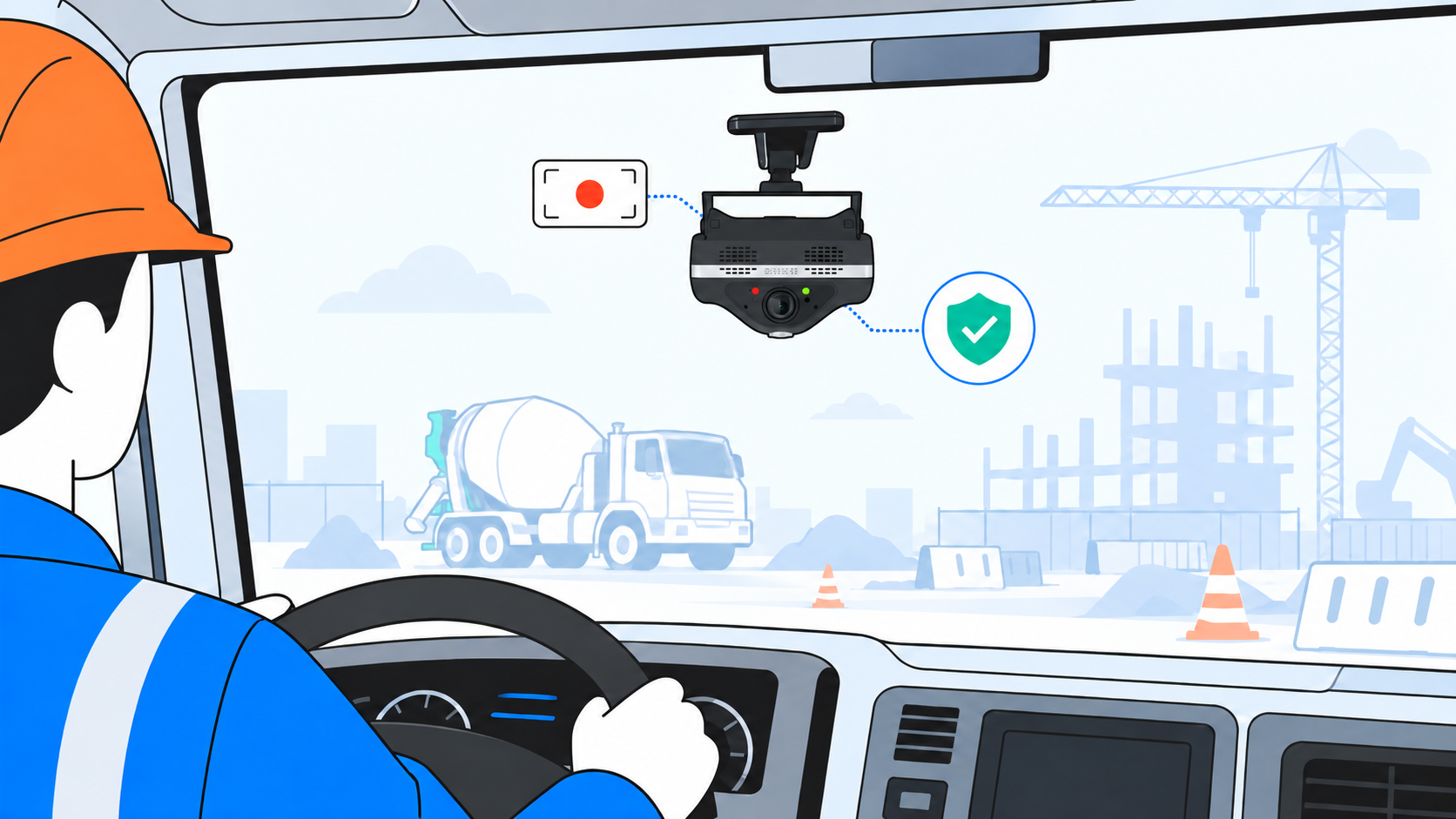
Each unit combines two lenses, one facing the road and one facing the cab, along with infrared sensors for low light, an onboard processor, an SD card for local storage, and a GPS module for location and speed.
The processor matters most: it runs the AI directly on the device instead of sending video to a server first. The industry calls this edge computing, and it means an alert reaches the driver in real time instead of after a delay, which matters when a truck is backing near a crew or exiting a job site onto a public road.
How the AI Learns to Recognize Risk
The AI behind the camera does not guess at what counts as risk. So how do AI dash cams work in construction vehicles when it comes to recognizing danger in the first place?
They run on computer vision models trained on real driving footage, including more than 20 billion miles of recorded driving data, learning patterns like drift, following distance, and driver fatigue instead of just measuring speed.

Real-Time Coaching the Moment Risk Appears
The system does not wait for a supervisor to review footage after the fact. So how do AI dash cams work in construction vehicles the moment risk actually appears? An audio alert reaches the driver inside the cab within seconds.
A driver merging out of a job site onto a highway gets a following-distance warning before traffic closes in, and a driver on hour ten of a shift gets a fatigue alert before a lane drift turns into something worse. Even a driver backing near a crew gets a warning tied to that exact maneuver.
One Dashboard Connects Video, Telematics, and Compliance
None of this lives in isolation from the rest of a fleet’s data. This is where AI dash cam integration in construction technology becomes visible, pulling several systems into one screen instead of scattering them across separate tools. Here is what that dashboard shows a safety director in one place:
Video events flagged by the AI, time-stamped and tied to GPS location
Maintenance schedules and diagnostic alerts for that same vehicle
Hours of service, inspection records, and other compliance documentation
Driver scores and behavior trends across the whole fleet
Click the button below to see the hardware and software running on vehicles like yours.